


Why Graded Steel Castings Matter: A Deep Dive
Introduction
In modern manufacturing and heavy industry, not all cast steel is created equal. The concept of graded steel castings—where alloys are specified, controlled and manufactured to tight grades—plays a crucial role in ensuring performance, durability, safety and cost-efficiency. For a company like Sumukh Steel Castings Pvt Ltd, which positions itself as a manufacturer of graded steel castings including stainless steel, manganese steel and heat-resistant alloys, this is central to both value proposition and competitiveness.
In this blog we explore what graded steel castings are, why they matter, how they’re produced, key industry applications and benefits, and how SSC aligns with these imperatives.
What Are Graded Steel Castings?
In simplest terms, a graded steel casting is a casting produced from steel alloy that meets a defined grade specification in terms of chemical composition (elemental makeup), mechanical properties (hardness, tensile strength, impact toughness), and sometimes heat-treatment state or microstructure.
Some key aspects:
-
Chemical grade, e.g., stainless steel (with defined chromium, nickel content), or manganese steel (with high Mn content) or heat-resistant steels/ alloys.
-
Mechanical grade, e.g., treated or as‐cast with defined hardness/toughness for particular service.
-
Casting size/complexity, where the foundry needs to ensure that even large single-piece castings meet the same grade uniformly. SSC, for example, claims single‐piece casting capacity up to 1 MT.
-
Finish state, e.g., raw casting vs. fully machined component, where the subsequent processes maintain the grade integrity.
Why use the “graded” term? Because in critical applications, the difference between one grade and another (for example a standard carbon steel vs. a high-manganese, high-hardness grade) can be the difference between success and failure in service.
Why Graded Steel Castings Matter
There are several reasons why grade matters in castings. Let’s break them down.
1. Performance & Wear Resistance
In heavy-duty applications—mining equipment, crushers, pump housings, propellers, under-carriage parts—components face extreme stresses: abrasion, impact, high temperature, fatigue, corrosion. Using the correct grade means the material is engineered to resist those stresses.
For instance:
-
A high-manganese steel casting will offer high work-hardening and abrasion resistance, suitable for wear-intensive service.
-
A heat-resistant steel casting will maintain strength at elevated temperatures where a standard steel would soften or deform.
-
A stainless steel casting will resist corrosion in aggressive environments (marine, chemical processing).
If one were to use a lower or non-suitable grade, the consequence is accelerated wear/failure, higher maintenance costs, unplanned downtime and replacement costs.
2. Safety & Reliability
Critical infrastructure or equipment often uses castings as structural or load-bearing components. If the casting grade is not up to specification, there is risk of cracking, fatigue failure, or catastrophic collapse. Ensuring graded steel castings means meeting defined mechanical properties, ensuring predictable performance and thus enhancing safety and reliability.
3. Predictable Life-Cycle Cost & Maintenance
While higher‐grade materials often cost more up front, they can dramatically reduce life-cycle cost: longer service life, fewer replacements, less downtime, less maintenance. For industries such as mining, cement, power generation—which SSC serves (as seen on the “Clients” list) —this can be a major differentiator.
4. Customization & Competitive Advantage
Many castings are bespoke: specific geometry, material grade, finish, tolerance. A foundry capable of graded steel castings can offer greater value to customers through custom grades, tailored to service conditions, giving them an edge. SSC’s profile emphasizes graded castings including stainless, manganese, heat‐resistant alloys.
5. Global Standards & Compliance
With many industries facing global supply-chains, international standards, certification requirements (e.g., ISO9001:2015) matter. Castings that meet graded specifications and come from certified foundries give peace of mind to OEMs and end-users. SSC’s “About Us” mentions ISO 9001:2015 certification.
How Graded Steel Castings Are Manufactured
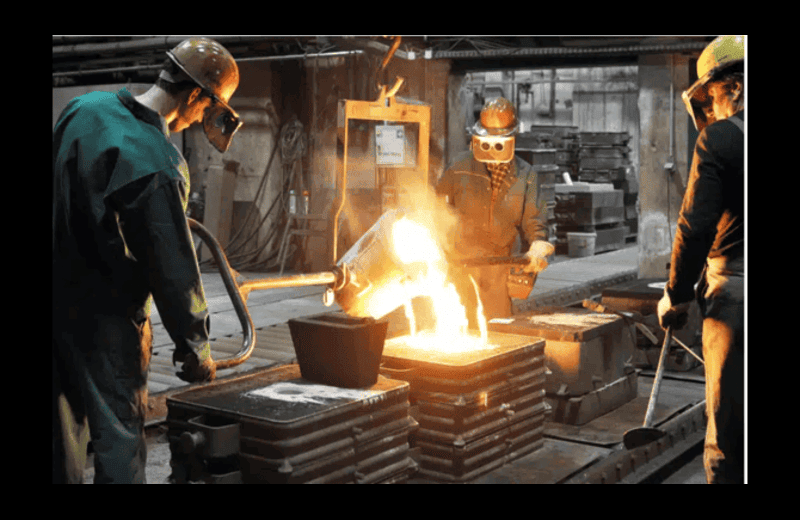
Understanding the production steps helps appreciate why quality matters and why not all foundries are equal. Here’s a general process, with notes on aspects that ensure graded castings.
Step 1: Specification & Design
-
Customer defines the grade (chemistry, mechanical property), size, finish, tolerance, function.
-
Foundry does feasibility: whether the grade can be cast to the size, geometry, finish required, and what gating/risers etc. required for sound casting.
Step 2: Melting & Alloying
-
The melting shop must be capable of producing the required grade: correct raw materials, accurate alloy addition, controlled melt practice. SSC’s history: started with 100 kg crucible, moved to 300 kg, then 500 kg, and now single‐piece up to 1 MT capacity.
-
Chemistry must be measured and controlled: for example manganese content, carbon content, trace elements.
Step 3: moulding, Pouring & Solidification
-
The mold shop must be capable of producing the casting size and shape. Gating and riser design must ensure sound metal, avoid shrinkage, porosity, etc.
-
For larger castings, cooling and solidification control are essential to maintain uniform properties.
-
Mold materials, cores, heat treatment provisions may differ for different grades.
Step 4: Heat Treatment (if required)
-
Many grades require post‐casting heat treatment: stress relief, normalization, quench & temper, etc., to achieve the desired microstructure and mechanical properties.
-
Foundries like SSC mention a “moulding shop, core shop, fettling shop, and in‐house quality testing laboratory”.
Step 5: Machining, Finishing & Quality Testing
-
After casting and heat treatment, machining, finishing (shot blasting, cleaning) bring the part to final dimensions & surface quality.
-
Quality testing is essential: chemical analysis, non-destructive testing (NDT), mechanical testing (tensile, impact, hardness), dimensional checks. A graded casting isn’t just about materials but confirming it meets the spec.
-
For SSC: they promote “world-class graded steel castings … supplied as both raw castings and fully machined components”.
Step 6: Supply & After-Service
-
Delivery must be timely and traceable. The supply of graded castings often involves documentation: certificate of compliance, material test reports, etc.
-
After‐sales support, warranty of material grade, failure analysis if service issues arise.
Case Examples & Typical Applications
Let’s review typical applications where graded steel castings matter—and reflect on how SSC might serve these.
Mining & Crushing Equipment
In mining, castings like jaw plates, crusher carriers, wear plates endure abrasion and impact. A manganese steel casting that work-hardens in service is superior to a standard cast steel. SSC lists “crusher jaw plates, carriers” in its product portfolio.
Under-Carriage / Heavy Equipment Components
Large castings for track frames, motor bodies, carriers, pump casings: size matters, grade matters. SSC’s large single piece capacity (1 MT) means they can serve big parts.
Pump & Impeller Housings in Chemical / Marine Environments
Here corrosion resistance, heat resistance, fatigue strength matter. Using the right stainless or alloy-steel casting is critical. SSC mentions “impellers, pump casings” in its catalogue.
Specialized Tooling & Heat-Treatment Trays
Grade plus accurate finishing. SSC lists “tool room Dies … heat‐treatment trays”. These applications demand tight tolerances and grade integrity.
Structural Castings in Construction / Power Generation
Large castings that serve as housings or frameworks require grades that will perform over years with minimal maintenance. Graded castings ensure this.
Why Partnering With a Foundry Like SSC Matters
Given the above, choosing the right foundry is crucial. Here’s how SSC aligns with the needs of the market:
-
Grade expertise & portfolio: SSC states they manufacture “graded steel castings including stainless steel, manganese steel, and heat-resistant alloys”.
-
Capacity & infrastructure: Their evolution from small crucible to 1 MT single‐piece capacity indicates they can handle large scale, heavy duty castings.
-
Quality systems & laboratory testing: Having an in‐house quality testing lab, and ISO 9001:2015 certification, suggests compliance and reliability.
-
End-to-end services: From raw castings to fully machined components; this full service reduces coordination for customers.
-
Geographic advantage: Based in Kolhapur, Maharashtra – accessible for Indian heavy industry supply chains.
-
Customization & client-focus: They list a wide client base across varied heavy industries, indicating flexibility.
Key Considerations When Specifying Graded Steel Castings
When you are selecting a casting supplier or specifying a graded steel casting, keep these factors in mind:
-
Correct grade selection for service conditions: Understanding the load, temperature, environment, wear/corrosion factors.
-
Foundry capability: Can the foundry cast the size you need, handle the grade you want, provide the finishing you require (machining, inspection)?
-
Traceability and quality assurance: Material test reports, chemical/physical certificate, NDT records, dimensional/geometry certification.
-


 English
 Arabic
 Français
 Español
 Português
 Deutsch
 Türkçe
 Dutch
Dutch
 Italiano
 Romaian
 Portuguese (Brazil)
 Greek
Greek