


Best Online Accountants UK: How to Choose in 2026
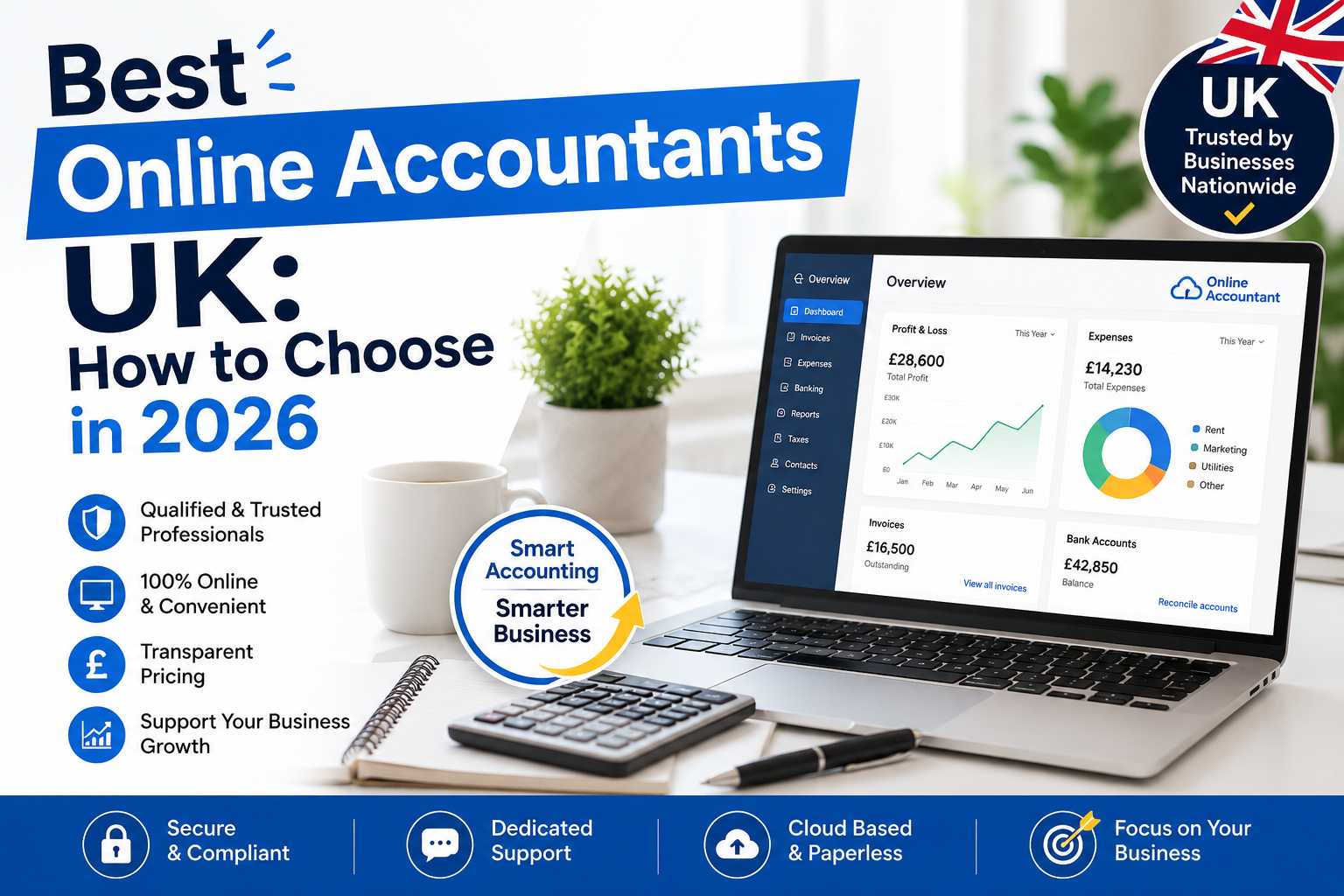
Best Online Accountants UK: How to Choose the Right Accountant in 2026
Choosing an online accountant can make financial management easier, but not every provider offers the same level of service. Price, software, communication, tax expertise, and the support included in a package can vary considerably.
The best online accountant for one business may not be the right choice for another. A freelancer, sole trader, limited company, and growing business can all have different accounting requirements.
The goal should be to find an accountant who understands your business, provides the services you actually need, communicates clearly, and can support you as your financial responsibilities grow.
What Makes an Online Accountant Worth Choosing?
Accounting Expertise and Business Experience
A good online accountant should understand more than basic bookkeeping.
Look for experience relevant to your:
-
Business structure
-
Industry
-
Turnover
-
Tax requirements
-
Growth plans
-
Accounting software
HMRC recommends checking an agent's experience, services, reputation, professional qualifications, and whether they can provide the support your business requires.
Clear Pricing and Included Services
A low monthly fee is not necessarily the cheapest option if important services are charged separately.
Before signing up, ask exactly what the package includes and whether additional fees apply to tax returns, payroll, VAT, year-end accounts, or advisory work.
Reliable Communication and Support
Online accounting should not mean limited support.
Find out:
-
How quickly questions are answered.
-
Who will manage your account.
-
Whether support is available by phone, email, or video call.
-
Whether you receive regular financial guidance.
What Services Should the Best Online Accountants UK Offer?
Bookkeeping and Bank Reconciliation
Accurate bookkeeping provides the foundation for reliable financial reporting.
Your accountant should be able to help maintain records, categorise transactions, reconcile bank accounts, and identify discrepancies.
Tax Returns and HMRC Support
An accountant can prepare relevant tax returns and, where authorised, deal with HMRC on your behalf.
However, HMRC makes clear that using an agent does not remove your responsibility for your tax affairs. You should review your returns before approving them.
VAT and Making Tax Digital
VAT support can be particularly valuable for businesses with complex transactions or growing turnover.
Making Tax Digital for Income Tax is also now a major consideration for many sole traders and landlords. From 6 April 2026, it applies to qualifying sole traders and landlords with income above £50,000, with the threshold reducing to £30,000 from April 2027 and £20,000 from April 2028.
A suitable accountant should understand compatible software, digital records, quarterly updates, and the relevant deadlines.
Year-End Accounts and Payroll
For limited companies and employers, year-end accounts and payroll can add significant administrative responsibility.
Check whether these services are included in your package or charged separately.
How Much Should You Pay for an Online Accountant?
Monthly Fees vs. Pay-As-You-Go Services
Online accountants commonly offer monthly packages, while some charge separately for specific services.
Monthly pricing can make budgeting easier, but compare the actual services included rather than simply choosing the lowest advertised price.
What Is Included in the Package?
Ask whether the quoted fee covers:
-
Bookkeeping
-
Self Assessment
-
Corporation Tax
-
VAT
-
Payroll
-
Year-end accounts
-
Tax advice
-
HMRC correspondence
The right package depends on your circumstances.
Hidden Charges to Check Before Choosing
Ask about additional charges for urgent work, extra transactions, payroll changes, tax planning, software, or services outside the standard package.
HMRC also recommends checking an agent's terms, fees, payment arrangements, and the services included before choosing one.
Are Online Accountants Suitable for Small Businesses and Self-Employed People?
Sole Traders and Freelancers
Online accounting can be particularly convenient for freelancers and sole traders who want digital bookkeeping and tax support without regular office visits.
Small Limited Companies
Limited companies often need more comprehensive support, including company accounts, Corporation Tax, payroll, and ongoing bookkeeping.
Growing Businesses With More Complex Needs
As a business grows, its accounting requirements can become more complicated.
A good accountant should be able to support changes in:
-
Payroll
-
VAT
-
Business structure
-
Cash flow
-
Tax planning
-
Financial reporting
How to Compare Online Accountant Reviews Before Making a Decision
Look Beyond Star Ratings
A high rating is useful, but it does not tell you everything.
Read individual reviews and look for comments about accuracy, communication, responsiveness, and problem-solving.
Check Communication and Customer Support
Poor communication can quickly become frustrating when dealing with tax deadlines or urgent financial questions.
Look for evidence that clients receive timely and useful support.
Compare Reviews From Similar Businesses
A freelancer's experience may be very different from that of a growing limited company.
Look for reviews from businesses with similar needs and structures.
Online Accountant vs Traditional Accountant: Which Is Better?
Convenience and Digital Access
Online accountants can provide digital document sharing, cloud accounting, remote meetings, and easier access to financial information.
This can be particularly useful for businesses that operate remotely.
Personal Support and Advice
Traditional and online accountants can both provide personal advice. The important question is how much access you receive to qualified support.
Technology, Cost and Scalability
Online services often make greater use of cloud software and automated processes.
However, technology should support good accounting rather than replace professional judgement.
7 Questions to Ask Before Hiring an Online Accountant
Before choosing a provider, ask:
-
What services are included in the monthly fee?
-
Do you specialise in businesses like mine?
-
Who will manage my account?
-
How quickly can I expect a response?
-
Which accounting software do you support?
-
Can you deal with HMRC on my behalf?
-
Will your services scale as my business grows?
HMRC also recommends speaking to several agents before choosing one and checking relevant professional qualifications or membership of an accountancy or tax body.
Conclusion
The best online accountant is not necessarily the cheapest provider. The right choice is an accountant who combines relevant expertise, transparent pricing, reliable communication, appropriate technology, and services that match your business needs.
In 2026, digital accounting is becoming even more important as Making Tax Digital requirements expand. Businesses should therefore choose an accountant who understands both current tax responsibilities and the changing digital requirements affecting UK businesses.
If you are comparing online accounting providers, Aksons Accounting can also be considered as part of your research, particularly when evaluating expertise, pricing, communication, and the range of services offered.
FAQs
1. Who is the best online accountant in the UK?
There is no single best accountant for every business. The right provider depends on your business structure, industry, accounting needs, budget, and level of support required.
2. How much should I pay for an online accountant in the UK?
Fees vary depending on the services required. Compare the total package rather than choosing based only on the advertised monthly price.
3. What should I look for when choosing an online accountant?
Consider relevant experience, qualifications, services, pricing, communication, software compatibility, reviews, HMRC support, and whether the accountant can support future growth.
4. Are online accountants suitable for small businesses?
Yes. Online accountants can be suitable for sole traders, freelancers, limited companies, and growing businesses, provided the service matches their accounting and tax requirements.
5. What is the best free accounting app in the UK?
The best option depends on your needs and eligibility. Free tools may work for basic record keeping, but businesses with more complex requirements may benefit from professional accounting software and accountant support.
6. Can an online accountant help self-employed people?
Yes. An online accountant can help with bookkeeping, Self Assessment, expenses, tax planning, and Making Tax Digital where applicable.
7. Can online accountants help with HMRC and Making Tax Digital?
Yes. An authorised accountant can deal with HMRC on your behalf, and agents can support clients with Making Tax Digital for Income Tax.


 English
 Arabic
 French
 Spanish
 Portuguese
 Deutsch
 Turkish
 Dutch
Dutch
 Italiano
 Russian
 Romaian
 Portuguese (Brazil)