


Recognition and Accreditation of Online One Sitting Degrees: A Complete Guide for Students in 2026
Introduction
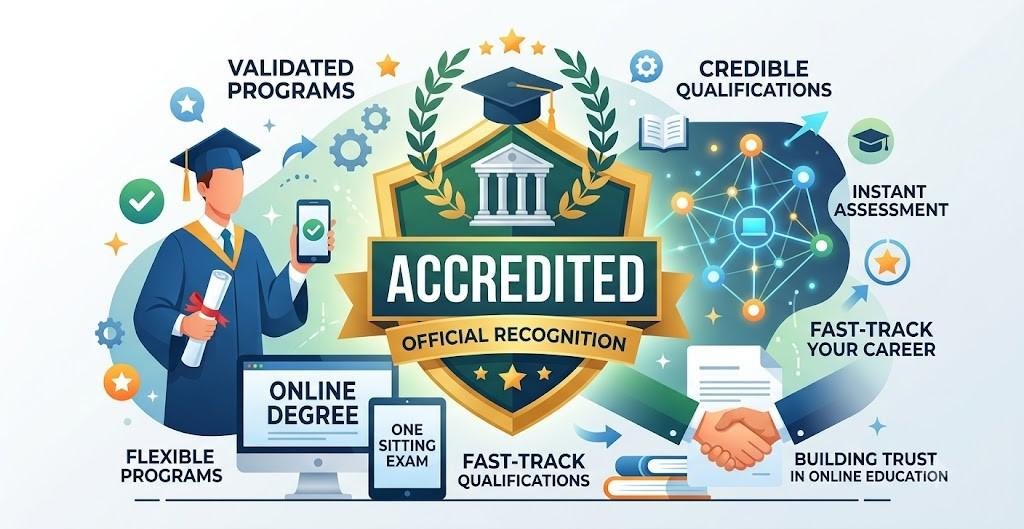
The demand for online one sitting degree programs has increased significantly in recent years as more students and working professionals seek flexible ways to complete their education. Individuals who have taken a break from studies due to work, financial challenges, family responsibilities, or personal reasons often look for faster and more convenient options to earn a degree. While online learning has made higher education more accessible than ever, students must pay close attention to one important factor before enrolling—recognition and accreditation.
Recognition and accreditation determine whether a degree is accepted by employers, higher education institutions, and government organizations. Choosing a recognized program helps ensure that your educational investment supports your long-term career goals. This guide explains everything you need to know about the recognition and accreditation of online one sitting degrees, how to verify a university's credentials, and the precautions every student should take before admission.
What Is an Online One Sitting Degree?
An online one sitting degree is an educational pathway designed for eligible students who wish to complete their graduation or post-graduation through flexible learning methods. These programs are often considered by individuals who have experienced an education gap or need to complete their studies while managing work or family responsibilities.
Students typically learn through online classes, digital study materials, recorded lectures, assignments, and examinations conducted according to university guidelines. Eligibility, duration, and academic requirements vary depending on the university and the student's previous academic qualifications. Therefore, students should always confirm the university's policies before applying.
Why Recognition and Accreditation Matter
Recognition and accreditation are essential because they demonstrate that an educational institution meets established academic and quality standards. A recognized university follows approved academic practices, maintains qualified faculty, and offers programs that comply with applicable educational regulations.
A recognized degree generally provides greater confidence to employers and educational institutions. It can also support eligibility for further education, depending on the admission requirements of the receiving institution.
Without proper recognition, students may face challenges such as:
-
Limited acceptance by employers
-
Difficulty pursuing higher education
-
Questions about the credibility of the qualification
-
Reduced career opportunities
-
Uncertainty regarding academic quality
For these reasons, students should always verify the recognition status of both the university and the specific program before enrolling.
Understanding Recognition in Higher Education
Recognition refers to the official acceptance of an educational institution by the appropriate regulatory or statutory authorities. It confirms that the institution is authorized to offer academic programs according to applicable regulations.
A recognized institution follows prescribed standards relating to curriculum, faculty, examinations, infrastructure, student support, and governance.
Recognition helps ensure that students receive education from institutions that operate within the established higher education framework.
What Is Accreditation?
Accreditation is a quality assurance process in which an authorized agency evaluates an educational institution against predefined academic standards.
The accreditation process examines areas such as:
-
Academic quality
-
Teaching methodology
-
Faculty qualifications
-
Research activities
-
Student services
-
Learning resources
-
Infrastructure
-
Governance
-
Continuous improvement practices
Accreditation provides students with an additional measure of confidence regarding the institution's commitment to quality education.
Difference Between Recognition and Accreditation
Although these terms are often used together, they have different meanings.
|
Recognition |
Accreditation |
|
Confirms that an institution is officially authorized to operate. |
Evaluates the quality of education provided by the institution. |
|
Focuses on legal approval and authorization. |
Focuses on academic excellence and quality standards. |
|
Usually granted by regulatory authorities. |
Usually awarded by accreditation agencies after evaluation. |
|
Indicates institutional legitimacy. |
Indicates institutional quality and continuous improvement. |
Understanding both concepts helps students make informed decisions before admission.
Important Regulatory Bodies in India
Several organizations contribute to maintaining standards in Indian higher education.
University Grants Commission (UGC)
The UGC is one of the principal statutory bodies responsible for coordinating and maintaining standards in higher education in India. Students should ensure that the university they choose is recognized by the UGC where applicable.
Distance Education Bureau (DEB)
The Distance Education Bureau oversees distance education within the framework established by the UGC. Students considering distance or online learning should verify whether the relevant programs comply with current regulatory requirements.
NAAC Accreditation
The National Assessment and Accreditation Council (NAAC) evaluates higher education institutions on academic quality and institutional performance.
NAAC accreditation grades indicate the overall quality of the institution based on multiple evaluation criteria.
AICTE Approval
For certain technical and professional programs, students should also verify whether the necessary approvals from the All India Council for Technical Education (AICTE) or other applicable regulatory authorities are required.
Is Recognition Important for Online One Sitting Degrees?
Yes. Recognition is one of the most important factors when choosing any online degree program.
A recognized institution generally provides:
-
Greater academic credibility
-
Better employer confidence
-
Improved opportunities for higher education
-
More reliable student support
-
Standardized academic processes
Students should avoid enrolling in institutions whose recognition status cannot be verified.
How to Verify Recognition Before Admission
Students should never rely solely on advertisements or promotional materials.
Instead, they should verify the following:
Check the University's Official Website
Review the university's official website for information regarding recognition, approvals, accreditation, and program details.
Visit Official Regulatory Websites
Students can verify recognition through the relevant statutory authorities' official portals whenever applicable.
Confirm Program Eligibility
Recognition of a university does not automatically mean every program has identical regulatory status. Verify the specific course before applying.
Request Documentation
Students may ask the admission office for official recognition or accreditation information and cross-check it with publicly available sources.
Read the Admission Guidelines
Review the admission brochure carefully to understand eligibility, curriculum, examination methods, and degree-awarding procedures.
How Accreditation Benefits Students
Accreditation provides several long-term advantages.
Better Educational Standards
Accredited institutions generally maintain structured academic processes and quality benchmarks.
Improved Learning Experience
Students often benefit from updated curricula, qualified faculty, digital learning resources, and continuous academic improvement.
Enhanced Career Confidence
Employers may have greater confidence in qualifications obtained from institutions with recognized quality standards.
Opportunities for Higher Studies
Accreditation may support applications for advanced education, subject to the admission requirements of the receiving institution.
Common Misconceptions About Online One Sitting Degrees
Myth 1: Every Online Degree Is Automatically Recognized
Not necessarily.
Students should independently verify the recognition status of the institution and program.
Myth 2: Faster Completion Means Lower Quality
Program structure varies between institutions. Students should evaluate curriculum quality, eligibility, academic requirements, and regulatory compliance rather than relying on assumptions.
Myth 3: Recognition Never Changes
Recognition and regulatory approvals may change over time.
Students should always verify the latest information before admission.
Myth 4: All Universities Offer the Same Programs
Different universities offer different courses, admission criteria, learning methods, and eligibility requirements.
Research is essential before making a decision.
Questions Every Student Should Ask Before Admission
Before enrolling, ask:
-
Is the university officially recognized?
-
Is the institution accredited?
-
What are the eligibility requirements?
-
What learning mode is offered?
-
How are examinations conducted?
-
What student support services are available?
-
What is the total fee structure?
-
What documents are required?
-
Is the curriculum updated?
-
How will the degree be awarded?
Obtaining clear answers helps students make informed decisions.
Tips for Choosing the Right Online One Sitting Degree
Selecting the right institution requires careful research.
Keep these tips in mind:
-
Verify recognition through official sources.
-
Check accreditation status.
-
Compare multiple universities.
-
Review student support services.
-
Understand examination procedures.
-
Compare fee structures.
-
Read university policies carefully.
-
Ensure the course aligns with your career goals.
-
Avoid institutions making unrealistic promises.
-
Keep copies of all admission documents.
Career Opportunities After a Recognized Online Degree
A recognized online degree may support career development across various sectors, depending on the student's qualifications, skills, experience, and the requirements of employers or educational institutions.
Graduates often pursue opportunities in:
-
Information Technology
-
Banking
-
Finance
-
Sales and Marketing
-
Human Resources
-
Business Administration
-
Customer Support
-
Education
-
Government recruitment (subject to applicable eligibility criteria)
-
Entrepreneurship
Career outcomes depend on many factors beyond the degree itself, including practical skills, experience, and individual performance.
Future of Online Higher Education in India
Online education continues to expand as digital learning technologies improve and more universities offer flexible study options. Working professionals, entrepreneurs, homemakers, and students from remote locations increasingly prefer online learning because of its convenience and accessibility.
As quality assurance systems continue to evolve, students are expected to benefit from improved learning platforms, enhanced student services, and greater transparency regarding institutional recognition and accreditation.
Final Thoughts
Recognition and accreditation are among the most important factors to evaluate before enrolling in an online one sitting degree program. A recognized institution that maintains appropriate quality standards can provide students with greater confidence in the value of their education and support their academic and professional aspirations.
Before making any admission decision, verify the institution's recognition, review accreditation information, understand the eligibility requirements, and compare multiple universities. Avoid relying solely on advertisements or unofficial claims. Taking the time to research your options can help you choose a program that aligns with your career goals while ensuring a credible and rewarding educational experience.
Ultimately, an informed decision today can contribute to stronger academic credentials, improved career opportunities, and a more secure educational future.


 English
 Arabic
 Français
 Español
 Português
 Deutsch
 Dutch
Dutch
 Italiano
 Russian
 Romaian
 Portuguese (Brazil)
 Greek
Greek